
Socialist Voice Review

April 2026
In For Peace, Independence and Socialism – Communists Gather for 27th Congress Jimmy Corcoran, current General Secretary, announces the next phase of development of the CPI concluding with: “We will be guided by Marxism-Leninism, not as a dogma which will give us the most “revolutionary” slogan, but as a tool with which to analyse the concrete political and economic situation and come up with the correct strategic position to advance the struggle for socialism.”
We will see how that plays out but in the meantime, our analysis of CPI National Congress – past and future Part 1 and Part 2 deals in some detail with how these events have been conducted in the past and with how the party has followed through on decisions and documents endorsed at these congresses.
The Necessity of a Revolutionary Party is an interesting look at the various issues that cause people to react or rise up in response to political and military events and it looks at possible ways to harvest such discontent or growing awareness. If some of the proposed steps were to be seriously considered it could lead to some interesting developments. Crucially, it even allows for hope: “This inevitability of a solution is something to be impressed on people. We, together, can and will solve this problem.”
However, the conclusion is far from scientific or realistic: “We will create a new and fair society. We will overthrow capitalism and put ordinary people in charge. This is an inevitable and certain fact.” Well, nothing is inevitable or certain and no amount of so-called “Marxist analysis” can make it so. In order to even start the process the author rightly draws our attention to, we will need a strong, disciplined and organised political force to lead and guide it.

The author is absolutely correct in stating “Discussion on this has to be a big part of our work. What exactly is the society we are trying to create? What are the steps? How do we lead and integrate?” but needs to be warned to watch his step if he starts any of that nonsense activity within the CPI.
Meanwhile, if you want to read an article that is short, informative and relevant to understanding some aspects of Ireland’s economy, then read Productivity’s Hidden Value Transfer. It provides an easy-to-understand analysis, whatever your level of knowledge of economics – with one exception. The author relies on the reader to know what “FDI” stands for (referring to Ireland’s reliance on Foreign Direct Investment) without spelling it out. Just spell it out: the reader who already knows what it means will not be offended by its inclusion and the reader who does not know what it means will not be demeaned by its exclusion.
Eoghan O’Neill in From Revolution to Reversal: Planning, Party Power and the Lessons of the Soviet Experience raised the standard for helping to understand the reasons for the collapse of the Soviet Union. It is quite difficult to get a comprehensive overview into a short article.
However, O’Neill manages to go a long way and acknowledges many aspects that have long been written out of history including the decisive role of the Stalin period in the development of the Soviet Union.
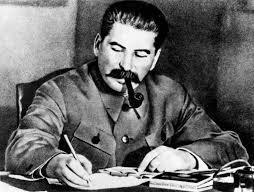
It would be interesting for O’Neill to expand on the significant roles of the Trotskyists and anarchists in their opposition to the Soviet Union as well as the effects of the unrelenting ‘western’ siege on all aspects of Soviet life – especially on how the genuine siege mentality led to the increasing – and fatal – power of the bureaucrats within the Communist Party of the Soviet Union.
In contrast, China’s Green Development is Both Anti-Imperialist and Socialist is long, detailed and…. evasive. It is quite common for the green revolution in China to be portrayed in entirely positive terms. Nothing is that simple and certainly a review of the article here can not adequately address the contentious issues. Sticking strictly with the proposition in the article title, there is plenty of information on China’s great strides in developing green technologies but every ‘development’ comes with a cost and the general disinclination to count those costs leaves a distorted view in its wake.
It gets more confusing when other factors are taken into account. The green march forward has been countered by a black fog backwards with a dramatic increase in 2025 in newly commissioned coal-fired power plants. Apart from any other considerations, if the upsurge in green technologies resulted in the replacement of fossil fuel energy generation, we could take a sympathetic view. However, instead of replacement we find that either or both these developments are in addition to each other.
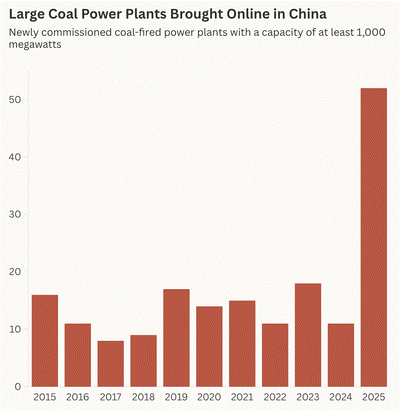
That means more and more production and more and more consumption. Sticking with the title, what is socialist about that? As for being anti-imperialist, if that amount of production is deemed necessary, why is its concentration in China? What about all the workers around the world who will get to consume the production but not produce it because of the monopoly that China has established for itself.
On the progressive side, China is a very serious subject not just for socialists but also for environmentalists. It deserves serious analysis and critical examination – in equal measure.
CPI Website
Over on the CPI website the desolation continues. In our March review we noted that there had been one update between 12 December 2025 and 8 March 2026 – that is, three months without an update. Another five weeks goes by and we are treated to another update Demand fuel and food sovereignty over corporate wartime profits (8 April) which ends with plenty of more “musts” including “We must be to the fore in demanding a radical social and economic strategy to secure national energy and food sovereignty.” “We must…..” Indeed, we must.
However, it is Working-class Anger (13 April) that stands out, for all the wrong reasons.
Once the ridiculous notions outlined in the article take hold in your brain and once you have admired the distorted imagination, it is difficult to know where to start a review so let’s start with the headline – “Working-class Anger.” The post relates to the fuel protests and proclaims as an opening gambit that “The current protests on our streets are a textbook expression of working-class anger. ”This is just not the case. It is nonsense – delusional and dangerous nonsense. As indeed, is most of the rest of the article.
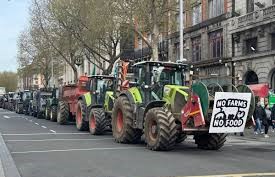
- Working class activists using usual preferred mode of transport to attend fuel protests
“The protests also reveal an important contradiction. They demonstrate a real capacity for organisation and coordinated action, yet in the absence of clear working-class leadership, that energy risks being misdirected. The far right is not leading these protests, but it is present, vocal, and organised.”
By this reasoning, there was a spontaneous uprising by the workers with no input from any left influence which begs the question, what is the point of having left-wing parties that are nowhere to be seen at crucial moments and if “….a textbook expression of working-class anger” can be generated and acted on without them?
Indeed, if we are to accept that this was a working-class revolt, we would have to accept that it was led by farmers and hauliers in the main. Now, that is an interesting concept! Alternatively, we might have to accept that any working-class involvement in the blockades involved workers being told what to do by their employers.

- Workers’ revolt supported by farmers and hauliers
The protests were very well organised but not by workers defending their interests. The interests in question were those of farmers and haulage entities (among others) being legitimately defended and showed an organisational capacity that puts the labour movement to shame.
Naturally, the CPI blames everybody else for the lack of leadership and, as usual, attempts to make the trade union movement the exclusive scapegoat. Somehow, the “far-right” can organise to take advantage of the situation but none on the left – not just the CPI but any outfit on the ‘left’ – can move in to exploit this “working-class anger.”
Why is this the case? “The far right is not leading these protests, but it is present, vocal, and organised. Where there is a vacuum, it will seek to shape events” the CPI statement continues. There has been a vacuum for the entire existence of the CPI and it has not managed to shape any organised resistance to anything.
As usual, with the CPI we end up in no-man’s-land: “What the current actions have shown is that effective direct action has the potential to shift the balance of forces and secure social, economic and political demands.
“This moment demands coordinated action. A national mobilisation on May Day, rooted in workplaces and communities across the country, should now be organised to give collective expression to the anger that exists and to assert a clear, independent working-class alternative.
“The central question is not whether anger exists, but who gives it direction. The task now is to ensure that it is organised in a way that builds unity, advances the interests of working people, and lays the foundation for a more just and sovereign economic model.”
How is any of this supposed to happen? Many people and organisations know what is wrong but they don’t know how to go about organising a start to the process of resistance and change.

More hollow calls for unspecified and disorganised ‘action’ is the last thing that is needed. It is precisely the absence of responsibility for the existence of the vacuum – displayed by the CPI in this statement – that creates the conditions for the political and leadership vacuums described in the article to exist. It also explains how such utter nonsense manages to be published as political commentary.
Desperation to appear relevant can lead to errors of judgement but this statement from the CPI is, by far, the worst drivel it has ever published. Once again, it is beyond embarrassing.